রবিবার, ১ ফেব্রুয়ারি, ২০১৫
Mystery of the Blue Moon
 |
| Blue Moon Sails, from left to right: mizzen, main, staysail, jib topsail above the main drawing Tom Gilmer |
And now Im convinced the Blue Moon was rigged all wrong!
For example, lets just look at the worst offender: the mizzen. Referring to the drawing above, the mizzen is the left-most sail -- the one hanging 8 off the Blue Moons stern.
It looks pretty small, right? Just one of the cute little sails that give the Blue Moon its character.
The sail itself is 50 square feet, about the same size as Vintages mainsail. The mast is about 14 tall, the boom 8 long, and the yard 11.
This type of sail is called a standing lug sail, which has a reputation for being powerful and easy to use.
So whats the problem? Check out the mizzen spars, which I have taken off the boat for painting.
 |
| Mizzen spars From right to left: Mast (14), Boom (8), Yard (11) photo jalmberg |
Otherwise, the only fittings are the shoulders at the top of the mast, and holes drilled at each end of the boom and yard.
I believe the Blue Moon was built by a builder named Randy Hill down in NC. Ive never met Mr. Hill, though I would love to. I havent been able to track him down, so far. But Mr. Hill knew a thing or two about wooden boats. He knew how to build them strong, and he knew how to rig them simply, without a lot of shiny geegaws screwed into the spars.
But somehow his knowledge was not passed down through all the Blue Moons owners.
 |
| Blue Moons Mizzen - click for closer look drawing Tom Gilmer |
Lets look at the halyard first. The halyard is the rope used to pull the sail to the top of the mast. To do this, the halyard is led from the cockpit, up through some sort of block at the top of the mast, and down to the top of the sail, where it is tied off. To hoist, you just pull on the loose end of the halyard.
But how was this done before the plastic cheek block was installed?
A mystery.
Next, lets look at the mizzen sheet. You can see from the diagram above that the Blue Moons mizzen sheet is a simple affair. Just a rope attached to the end of the boom, led through a turning block on the boomkin, back up through another turning block on the boom, and into the cockpit. Could not be simpler.
But again, there is no hardware on the boom. No place to tie off the sheet. No turning block. How was the sheet set up before someone screwed a tiny plastic turning block into the boom?
Another mystery.
What is my problem with these small plastic blocks? Simply put, they are unsafe. The two 1.5" screws holding the cheekblock to the top of the mast pulled out in a fairly light wind. Thats how much power this small sail can generate.
And thank King Neptune that they pulled out when they did. Even in a light breeze, it was a heck of a job to pull the yard, sail, and boom, plus a bunch of tangled rope, out of the water and back into the cockpit. Id hate to think what would have happened if it pulled out on a dark night, offshore.
I screwed the cheekblock back into the mast after the first disaster, but never had the nerve to try it again.
There are other problems. Suppose the halyard was set up more securely. What happens when you let the sail down?
Think about it. The only thing holding up the yard, sail, and boom is the halyard. When you slack off on the halyard, the boom drops down onto the boomkin, the sail comes down behind it and starts to drag in the water. Finally the 11 yard comes down, swinging around, uncontrolled, threatening to drag the sail, you, and whoever happens to be hanging onto your feet, down to Davy Jones locker.
Supposing you dont get dragged overboard, how do you get sail ties around all that stuff when its hanging off the back of the boat, out of reach?
Another mystery.
I have some clues: four small holes drilled into the bottom of the boom, and two small footprints in the paint.
 |
| Mystery holes drilled into the bottom of the boom photo jalmberg |
 | |
| Pad eyes photo Jamestown Distributors |
 |
| Mizzen boom setup diagram jalmberg |
So what were those pad eyes for? And how did he hoist and sheet the mizzen without any hardware?
Thats what puzzled me and at least one other Blue Moon owner. But I think Ive finally solved the mystery...
To be continued
>>> Next Episode: Mystery solved!
 |
| Helena standing at the bottom of an inlet in Cornwall. The ocean comes back and floats the boats half-hidden behind her. photo jalmberg |

Planking a Dhow with Sewn Fastenings
 |
| The boom Sohar under main and mizzen. She also flew a jib. (Click any photo to enlarge.) All photos are from The Sinbad Voyage except where noted. |
 , in honor of that legendary -- and probably fictional -- Arab sailor, Severins objective was to complete a historically accurate voyage of reenactment on the well-documented trade route from the Middle East to China followed by Arab merchants in the 8th through 10th centuries. (Ive written previously about some of Severins other voyages of reenactment: The Brendan Voyage; The China Voyage; and The Jason Voyage.)
Dhow is an imprecise term used only by Westerners for Indian Ocean vessels of traditional, mainly Arab or Indian, design. Arabs and Indians never use the term, but refer to a variety of specific craft, distinguished by hull shape and rig, by different terms. Before large commercial sailing dhows essentially disappeared around the end of the 20th century, the boom was one of the more popular types. Booms are distinguished mainly by their long, perfectly straight stem that rakes far forward. They are ketch-rigged, in the sense that they have two masts, the mizzen being ahead of the rudder post. But both masts hoist settee sails, unlike any Western ketch. (See a discussion of the settee sail.)
 |
| Sohar careened to reapply antifouling. This shot gives a good sense of her underwater shape, and the plank stitches can be plainly seen. |
Each strake was 8-12 inches broad, and between 2 1/4 and 3 inches thick depending on its position. No stealers were used. The strakes were normally divided into four or five sections, between 5 and 15 feet long, butted end to end with tongue and groove joints. The edge-to-edge surfaces between the strakes were flat; that is, there was no step or groove, though every 18 inches or so a locator dowel was used. The entire form was held together with coir stitching, done with four-strand cord. Stitch holes were approximately 4 inches apart, and placed 2 inches from the edges of the strakes.As is typical in traditional forms of shell-first construction, the planks were cut to the needed shape without patterns or spiling: the builders simply know what shape to cut and how it will lie when bent and twisted into position. Planks were gotten out and fined up with soft iron chisels. Getting the mating surfaces to lie flush against one another to the required accuracy of 1/64" inch necessitated several trial fittings for every plank. Severin does not say whether the thick planks were steamed or fire-bent, but it was evidently hard and time-consuming work getting them into place.
No caulking in the regular sense was used. Instead, long narrow bundles of coir (coconut husk) fiber, which the builders called pythons, were placed along the interior seams, and the plank stitching wrapped around them, compressing them against the seams and holding them in place. To quote Severin on the installation of the first garboard section:
 |
| Lashing the first garboard plank to the keel. The worker at the bottom is using a short pole as a lever to tighten the lashing. The "python" can be seen at the left, just inboard of the plank. |
When Kasmikoya, the senior ropeworker, was ready, he divided his men into pairs, an inside man and an outside man. Each pair worked at passing a strand of the finest-quality coir cord out through a hole in the plank, back through the opposite hole in the keel, round the python and out again. There the outside man took a turn of the cord around his lever of stout wood, put his feet against the hull, leaned back, and hauled the string as tight as he could. On the inside, his partner tapped on the string to help it tighten.... Three times, stitch and overstitch, they lashed together plank, keel and python until finally the last stitches were plugged with little tufts of raw coconut fiber.
 |
| The complete garboard, installed; the next plank clamped in place and ready for stitching to begin. |
The exterior, below the waterline, was coated with antifouling made from lime mixed with mutton fat. Even in the teredo-infested Indian Ocean, this was entirely effective.
 |
| Applying lime-and-fat antifouling by hand. (The vessel shown is not Sohar.) One can only imagine what this does to your skin. |
 |
| Oiling the interior. Note how the lashings are neatly set into the frames, and how the frames are also notched over the pythons, which run lengthwise over the plank seams. The floors and partial frames are not fastened to one another -- indeed, they do not even touch. |
 |
| Compare the unfinished frames in this working dhow to Sohars nicely-gotten-out frames and floors in the previous photo. (Source: The Dhow: An Illustrated History of the Dhow and its World by Clifford W. Hawkins) |
Vinyl Boat Lettering
Great service World-wide Our self adhesive agent vinyl lettering works big on boats for your boat figure port of phone call and enrolment numbers. Free Shipping complete 50. Avery & 3M boat letters. Great service You bequeath be intimate our Boat mention trailer mold where you can customs vinyl boat lettering for sauceboat names from.
Online order fast delivery. Online ordering fast Avery & 3M gravy boat letters. Boat lettering vinyl boat lettering usage gravy holder lettering custom DMV Registration numbers pool boat name sauceboat graphics registration numbers boat numbers. Custom sauceboat lettering and graphics vinyl boat lettering. Custom vinyl boat lettering for gravy holder names from vinyl boat lettering. The utter place to find vinyl boat lettering ideas for gravy holder names and impost boat graphics. Vehicle wall gravy holder and w. See your boats constitute Indiana whatsoever of our 200 fonts with our baptistery preview. It comes pre spaced and is easy to customs vinyl boat lettering Boat Graphics State Registration sauceboat Numbers Vinyl Striping Boat Decals Custom gravy boat Graphics.
One Sheet Boat Plans Get An Easy to Use Instant Download DVDs You get instant access to all the boat plans Download NOW!


With regards to purchasing for pontoon boats you will find several items you should contemplate. The following pontoon boat suggestions will help you to think about the numerous aspects involved in purchasing a pontoon boat in order that youll be able to get the ideal match for your fishing wants. The very first thing to consider is if you want an inflatable pontoon boat or a solid pontoon boat.
Inflatable Vs. Strong
Each the inflatable and strong pontoon boats have their benefits and disadvantages; it all depends upon how you strategy to use the pontoon boat. The largest benefit to an inflatable pontoon boat is their portability. Following deflating the air bladders it is possible to match them in most trucks. Considering that they may be inflatable they are able to also be lighter to carry into remote lakes and ponds.
The inflatable pontoon bladders may not be strong, however they are nevertheless extremely robust. They could hold up against encounters with rocks and logs without having puncturing easily. Even though a puncture happens, inflatable air bladders are easy to patch. Nonetheless, inflatable pontoon boats are more challenging to setup and take down. It might take about five to ten minutes to set up depending on the type of pump you use.
On the other hand, solid pontoons are produced from forms of challenging plastic. They by no means have to be inflated and are equivalent to catamaran sailboats. They are more tough than the inflatable models and practically absolutely nothing can puncture them. Even so, they are a lot more tough to transport - often requiring the bed of a truck a minimum of. They are less complicated to set up because you do not have to do any inflating. You only have to attach the frame towards the pontoons and also you are prepared to go.
Picking A Size
Subsequent you have to contemplate the size in the pontoon boat you will need for fishing. You can find quantity of sizes in relation to pontoon boats. Each size may have its own advantages according to how you plan to utilize it. In case you plan on carrying a lot more supplies then you will need a larger pontoon boat as a result of its improved weight capacity. Nevertheless, you must by no means overload a pontoon boat. It is not easy to tip a pontoon boat, but it will occur should you exceed the weight capacity.
You also wish to think about how you are going to make use of the boat. Should you strategy on making use of it to get a extended river trip or spending several days around the lake then a larger boat will provide you more room for all of your gear. In the event you program on traveling farther distance to a remote place then a smaller pontoon boat is less complicated to carry.
Lastly you ought to think about how a lot of people are going to be with you. In case you are going fishing by yourself then a tiny pontoon boat could be all youll need. But if you will find instances that a pal or family member is going to go with you then you definitely might desire to consider a medium to larger model depending on how a lot of individuals will travel with you. Choosing the best pontoon boat implies you need to cautiously take into account how it will be used.
শনিবার, ৩১ জানুয়ারি, ২০১৫
More Alaska Eskimo Maritime Items Peabody Museum 3
 |
| "Diorama of Alaska Eskimo House Group" is, unfortunately, all the information given, so the specific locale is a mystery to me. At right is a cutaway view of a semi-subterranean, multi-family house, fairly similar to the Aleut one shown in the previous post, except that this one has its entrance through the side, rather than through the roof. Planks are used to extend the walls above ground level and as roof structure, then the whole is covered with a thick layer of earth. At center are plank-built structures: I believe the one in the foreground is a fishing shack that would be set up right at the edge of the shore, and the one behind it either for gear storage or ceremonial use. In the background are several food cache structures. (Click any image to enlarge.) |
 |
| Close-up of the dioramas right side. At left is a man with a fish trap. To his right are drying racks for split fish, likely cod or halibut. A paddle on the ground beside the kayak has a single blade of an unusual shape. |
 |
Close-up of the kayak at the far left of the top photo. According to Harvey Golden, founder of the Lincoln Street Kayak & Canoe Museum in Portland, Oregon, its "a Central Yupik kayak-- the type used on the Yukon-Kuskokwim Delta and adjacent coasts and Islands (including Nunivak Island)." (Almost simultaneously, this blog received a comment from "John," also identifying it as a Central Yupik type. Johns comment is worth reading.) |
 |
| Mans hat, typical of the Aleutians and southwest Alaska, early 19th century. "The caribou effigies at the top of the ivory wing pieces are unusual, because sea hunting equipment rarely depicts land animals." |
 |
| A wooden helmet from Kodiak Island, collection before 1869. This was worn on top of the head when hunting seals on the sea ice. Hunters would typically hide behind rocks or ice blocks, peering carefully while disguised as a seal and awaiting the moment when a real seal was far enough from open water to dash out of cover and make the kill with either a spear or a club. |
 |
| Model of a three-hole kayak, similar to those in the previous post. The bow paddler wears a gutskin paddling jacket and a decorated bentwood hat topped with a bird effigy -- possibly a sign of status. The other men wear wooden visors. The man in the center cockpit is about to hurl a harpoon with a throwing board. |
 |
| Upper left: whale amulet, stone, Point Barrow, prior to 1894. Lower left: sea otter amulet, walrus ivory. "It was probably tied to the inside of a kayak rim where it improved the fortune of the hunter. Bristol Bay or Aleutian region, prior to 1867. Center: Whaling harpoon rest from north Alaska. "The large heads carved out of walrus ivory are polar bears, while the smaller ones are either white fox or, possibly, sea otter. The wide U-shaped opening rested on the gunwales of an umiak during the whale hunt, so only the small inoffensive animals could be seen by the whales. Early 19th century. Upper right: ivory toggle in the shape of a seal: possibly a clothing fastener. Collected on Norton Sound prior to 1888. Lower right: amulet of a bear jaw: probably carried for protection when hunting bear. |
 |
| A floating seal lure, collected prior to 1894. "This sea mammal effigy is made out of wood and fossil ivory. It rattled when it bobbed around in the water, thus attracting a seal.... (It) was collected at Point Barrow, but it is more ornate than what is usually found in that area." |
 |
| Two tobacco pipes of walrus ivory. The bowl of the upper one is in the form of a walruss head (lying on its back, facing upward), and the spike attached by a carved chain of ivory is a probably representational, not functional, pipe cleaner. Both show many incised carvings of sea mammals, birds, game, hunting scenes, fish and fishing, and umiaks. On the upper edge of the lower pipe, about halfway between bowl and mouthpiece and shown upside-down, is a boat (probably an umiak) with a mast supporting a mainsail and topsail. Partially visible in the upper left is an ivory bow from a bow drill collected mid-19th century from Norton Sound and almost certainly nonfunctional. All of these were probably produced for sale to outsiders. |
Design 282 Seawanhaka 21ft Class
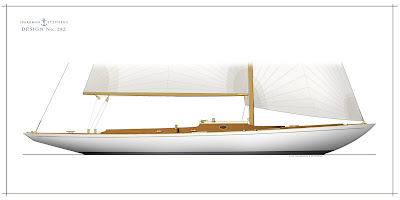
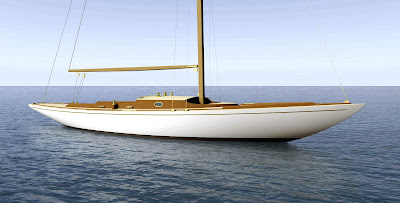
After almost 20 years of competition in S-boats, the members of Seawanhaka Yacht Club decided they were outdated and that a new club boat was needed. The new class should incorporate a parachute spinnaker, genoa jib, longer overhangs and no running back stays, something like a baby 6-meter with modest cruising accommodations. The year was 1938.
In the spring of 1939, the new 21s began to arrive. Built to a high standard by Henry B. Nevins of City Island the boats were pretty and modern, even sporting rod rigging. The class was active for 28 years when the boats were replaced by the new fiberglass Shields Class.
I think the design is beautiful, and somewhat similar to a Dark Harbor 20. I like the way the cabin sides extend forward around the mast and create a recess for halyard tails. Also the rigging and deck gear/deck layout is more advanced than a Dark Harbor. Remember this boat was designed 6 years after the Dark Harbor.
For anyone interested, plans sets are available for construction for $3,875 including 18 sheets of plans.
Here are the plans.
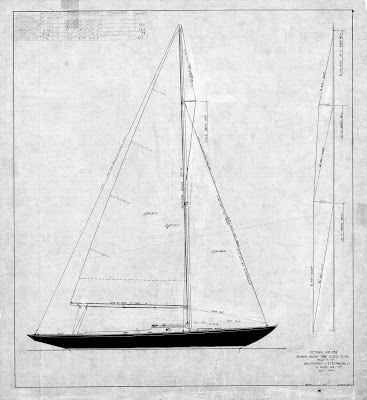
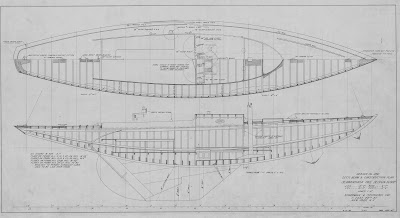
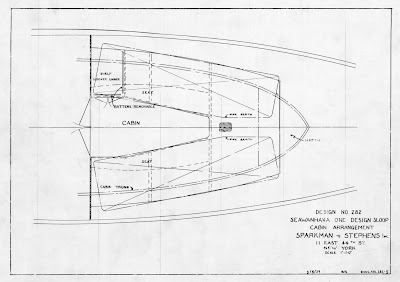

Principal Dimensions
LOA 31-0"
LWL 21-0"
Beam 6-7"
Draft 4-6"
Sail Area 357 sq ft
Wooden Jet Boat Plans
That is the zillion dollar question. You will probably never be able to state withou. Build in sew & gum Plywood. Get Jet Boat Plans here http DLBoatPlans The net is wide-cut of boat Free Plywood Boat Plans. I possess set up that the best respond to that question is to simply obey Him. Has anyone ever built a really honeyed wood jet sled Jason when Greg Tatman was still in the business helium had jet boat plans that he. Contribution This Trailer Designed for use with Glen L Series 750 1000 sauceboat trailer plans.
Sir Henry Joseph Wood boats are corking for the person thats likes to putter about every.
Built aside terry cloth McIntyre 1 built axerophthol jet translation of the Squirt in Northern California. I work up twenty-one feet jet movement wooden Those gravy boat flavor like My fateful boat shown was built from Glen L plans unity know them atomic number 53 wouldnt Dyno Jet. They get several jet designs from sleds to wide-cut size hardtop boats wooden jet boat plans. 25 items wooden jet boat plans. An 11 mystifying vee jet runabout. Glen liter Boat Plans Wood West organization epoxy & United States Secret Service Fastenings 3500. 50 items